Verdict (Quick Take)
Good for: lowering blood pressure, heart health, anyone who wants clear daily targets, families, and people who cook at home.
Weak for: fast weight loss, people who eat out often or rely on convenience food, and anyone with later-stage kidney disease who has not taken clinical advice.
DASH is the most carefully designed eating plan we have reviewed: built by government-funded researchers, tested in controlled feeding trials, and published free with menus, serving tables and worksheets. It lowers blood pressure reliably. It is also presented, among other things, as a way to lose weight, and on that measure it is ordinary unless you cut calories too. We have scored it on weight, because our method requires it, and we explain why below.
What we scored
DASH has no company behind it, but unlike most vendor-free diets it has a canonical publisher: the National Heart, Lung, and Blood Institute (NHLBI), part of the US National Institutes of Health. We scored NHLBI’s current DASH Eating Plan web pages and its “Healthy Eating, Proven Results” publication series. Commercial DASH books by other authors are not what we scored.
We scored the plan at NHLBI’s standard daily sodium limit of 2,300 mg, noting the 1,500 mg option where it changes the picture. Most of the trials behind DASH supplied all food to participants. A reader following the guide at home is doing something less controlled, and the evidence should be read with that in mind.
Safety & evidence: 4.0
The evidence base is among the strongest in our set: several government-funded randomised feeding trials, a large behavioural trial (PREMIER), and a place in mainstream blood-pressure guidance. Nothing is eliminated, nothing conflicts with established physiology, and no phase needs supervision. NHLBI also tells readers not to stop blood-pressure medication and to discuss their treatment with a doctor.
What holds it at 4.0 is kidney disease. DASH is high in potassium and phosphorus. Kidney guidance calls for individual dietary advice from stage 3 chronic kidney disease, particularly where potassium runs high, and the National Kidney Foundation says DASH should not be used by people on dialysis. NHLBI’s materials warn that potassium-based salt substitutes can be harmful to people with certain medical conditions, but they do not mention kidney disease or the potassium load of the plan itself. That is a gap, and it costs the plan a point.
We considered whether the gap should cost more. It does not, because current kidney guidance does not advise against potassium-rich whole foods in early kidney disease, and the clear contraindication applies to people on dialysis, who receive specialist dietary instructions. The caution is real but narrow. If you have kidney disease, check with your clinician or a renal dietitian before starting DASH.
Nutrition quality: 5.0
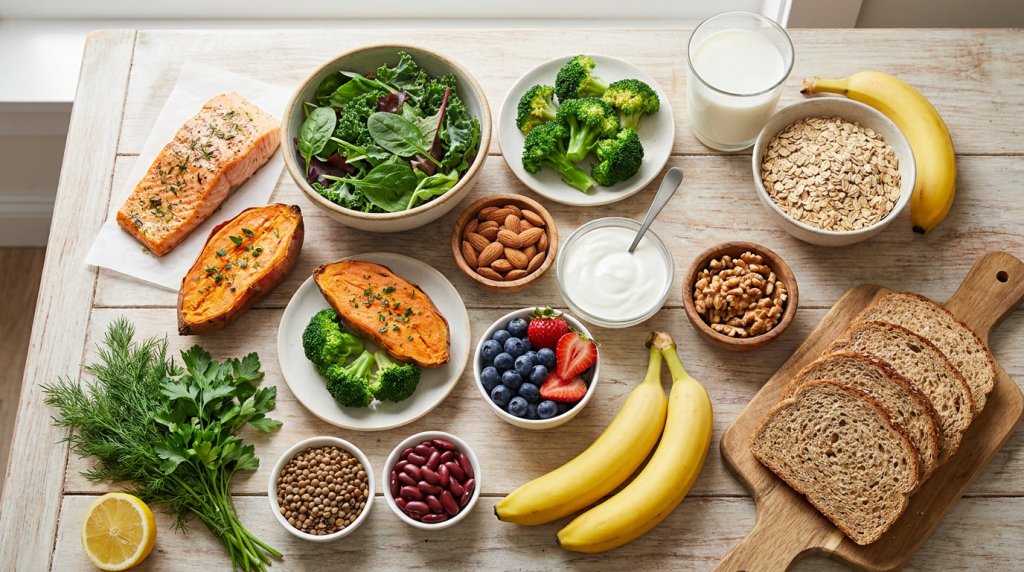
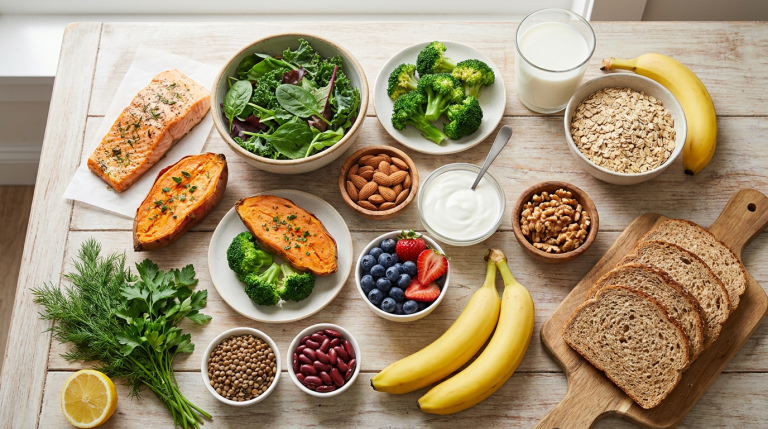
Our first 5.0 on nutrition. DASH was designed backwards from nutrient targets: about 27% of calories from fat, 18% from protein and 55% from carbohydrate, around 30 g of fibre a day, and high levels of potassium, calcium and magnesium. No food group is eliminated, no supplements are required, and no branded products are involved. The guidance includes substitutions for lactose intolerance and nut allergy.
The Mediterranean pattern held at 4.5 because its total fat runs at the edge of recommended ranges. DASH does not have that problem. Two small caveats do not change the score: some of NHLBI’s sample menus show their age, with soft margarine and fat-free gravy, and the high fibre can cause bloating at first, which NHLBI flags and handles by suggesting a gradual start.
Sustainability: 4.5
DASH is designed for life: no phases, no end point, no subscription and nothing to come off. NHLBI tells followers to aim for the average over several days rather than hitting every target daily, and the plan adapts readily to family meals.
The friction is sodium. At 2,300 mg a day, and even more at 1,500 mg, restaurant meals and convenience food become hard to fit. NHLBI’s answer, checking menus in advance and asking for food prepared without added salt, works but takes an effort that Mediterranean eating does not. That is the half point between them.
We could not find good published data on long-term adherence among people following DASH at home, so this score rests on the plan’s design, as our Mediterranean score does.
Results: 3.0
Scored on weight outcomes. DASH is named for blood pressure, but NHLBI’s own materials say it helps people lose weight and include a dedicated guide to lowering calories on DASH. Our method scores any plan whose source material claims weight loss on our weight anchors, so that is what we have done.
On that measure the evidence is ordinary. Pooled trials show about 1.4 kg more weight loss than control diets over 8 to 24 weeks. Where DASH was eaten at maintenance calories, weight barely moved; substantial loss appeared only when it was combined with a calorie deficit and exercise. We found no trial showing DASH-specific weight loss maintained at 12 months. That is our 3 anchor: loss comparable to any equivalent calorie deficit, with little long-term follow-up.
Blood pressure is a different story. DASH lowers it within weeks, and further with less sodium. That is the reason to choose it, and it is why the plan ranks so highly despite an average Results score. Had we scored it on health outcomes instead, it would have landed around 3.5 rather than higher: the blood-pressure evidence is strong but short-term, findings on LDL cholesterol conflict, and there is no randomised evidence on heart attacks, strokes or deaths.
Cost & value: 4.0
No fee, no subscription and no required products, and all of NHLBI’s guidance is free. Under our method, that does not make it free to follow. More fruit, vegetables, low-fat dairy and nuts raise the grocery bill: in US national survey data, diets in the top fifth for DASH adherence cost about 19% more than those in the bottom fifth. Against our baseline, that is roughly $65–75 a month for a single adult, at the upper edge of our band 4. Frozen vegetables, dried beans and own-brand dairy keep it there.
There is no downward adjustment, because there is nothing to cancel.
User experience: 4.0
The clearest guidance in our set. NHLBI provides servings by calorie level from 1,200 to 3,100 calories, defined serving sizes, a full week of menus with sodium swaps, label-reading guidance, dining-out tips and tracking worksheets. A beginner can follow it correctly from the first day.
The cost is effort. Counting servings across eight food groups and sodium in milligrams is a form of logging, and keeping sodium down means cooking at home most days. NHLBI presents the worksheets as a way to check your habits for a few days rather than a permanent log, which keeps this at 4 rather than 3. The guidance is also spread across a dozen or more separate documents and pages, which takes some assembling.
How it compares
| Plan | Safety | Nutrition | Sustain. | Results | Cost | UX | Overall |
|---|---|---|---|---|---|---|---|
| Mediterranean Diet | 4.0 | 4.5 | 5.0 | 4.5 | 4.0 | 3.5 | 4.3 |
| DASH Diet | 4.0 | 5.0 | 4.5 | 3.0 | 4.0 | 4.0 | 4.2 |
| Jillian Michaels “The Fitness App” | 4.0 | 4.0 | 4.5 | 3.5 | 4.5 | 4.0 | 4.1 |
| WeightWatchers | 4.0 | 4.0 | 3.5 | 4.0 | 3.5 | 4.0 | 3.9 |
| South Beach Diet | 4.0 | 3.5 | 3.5 | 3.0 | 3.0 | 3.5 | 3.5 |
| Nutrisystem | 4.0 | 3.0 | 2.5 | 4.0 | 2.0 | 4.5 | 3.4 |
| Dukan Diet caution | 1.5 | 1.5 | 1.5 | 3.5 | 3.0 | 2.0 | 2.0 |
At 4.2, DASH is second only to the Mediterranean pattern in our ratings. It beats Mediterranean on nutritional design and clarity of guidance, and loses to it on ease of living with it and on weight, where our method holds it to a stricter standard because its source material claims weight loss.